
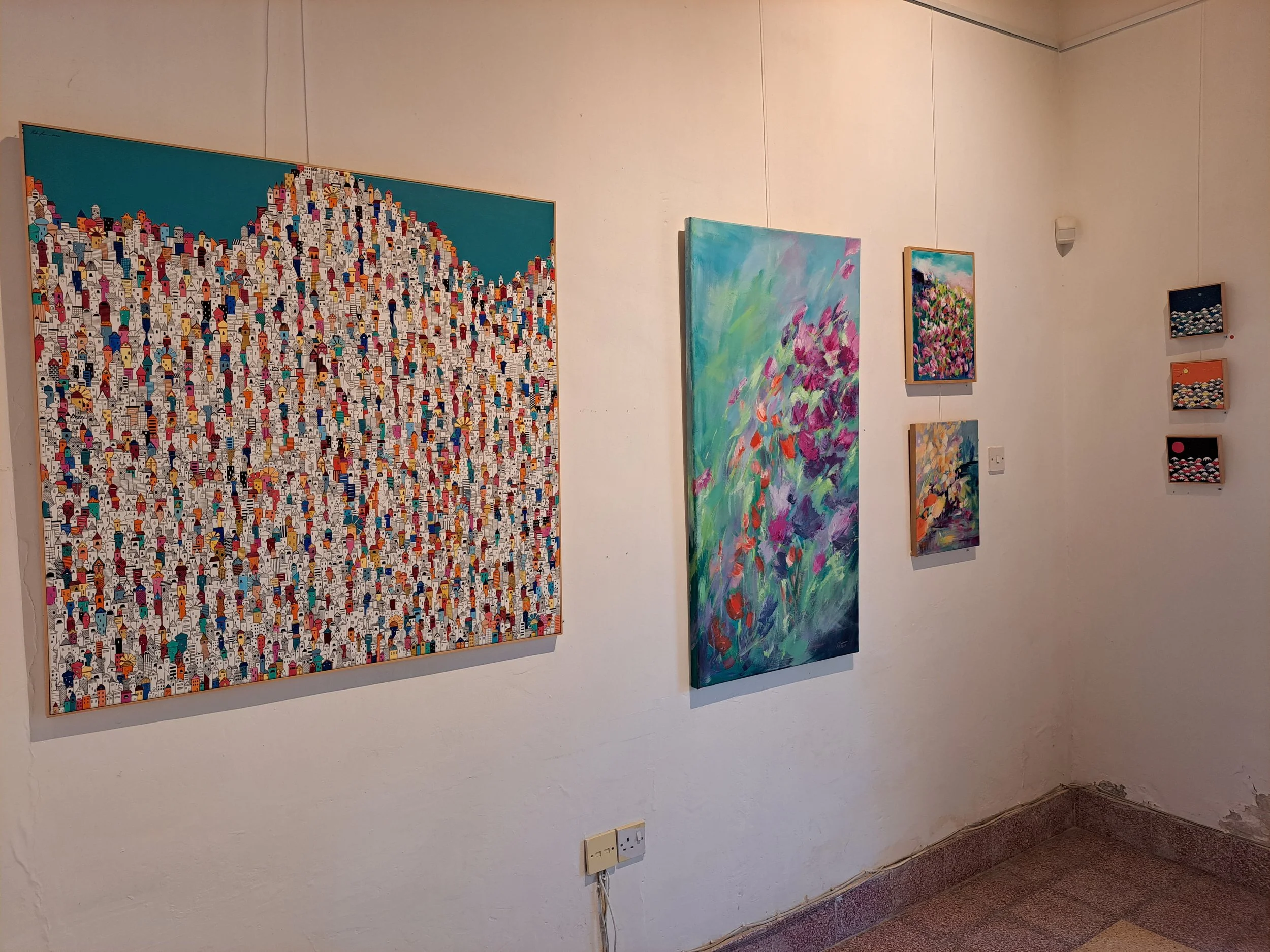
I spent two years on my knees building a city that doesn't exist
Some people used lockdown to learn a new language, bake sourdough bread, or get really good at home workouts. I decided to build an entire city.
One tiny house at a time. On my knees. For two years. My lower back still hasn't forgiven me.
It all started during the first COVID lockdown, when a small painting of colorful houses I shared on Instagram caught the attention of a friend, who immediately bought it and took it home to the UK.
Encouraged by that little success, I decided to take on a much bigger project: a one-meter-by-one-meter canvas filled entirely with tiny houses. Hundreds of them, each with its own little windows, doors, rooftops, and details.
What I hadn't considered was that this would involve countless hours crouching on the floor, sketching house after house. My knees were suffering, my lower back was filing formal complaints, and I was surviving mostly on boiled eggs and crackers, with occasional breaks for my 100-squats-a-day challenge. Because, well, lockdown. Crazier things were said to have taken place during those days.
But there was something meditative about the process. I loved watching the little houses come together and slowly turn into a city. And there was another reason I wanted to paint it.
Every little house was a wish
At the time, I was working for a nonprofit supporting refugees in Syria and Lebanon. Through my work, I came across many stories of children who had lost their homes, schools, and sense of security.
As I sat drawing hundreds of tiny houses, I kept thinking about them. Each little house became a wish, almost a prayer, that every child would have a safe, stable, and loving home where they could simply be children.
Without really planning it, I was painting something much more personal than a colorful city. I was painting a little world where everyone had somewhere to belong.
A city on a hill
When I eventually finished the painting, I called it City on a Hill.
Interestingly, I later discovered the deeper historical and biblical symbolism behind cities built on hills. In ancient times, elevated settlements were often chosen for protection, but their visibility was also important. A city on a hill could be seen from far away. For someone searching for shelter, it could represent a destination, a place of refuge, somewhere to move towards.
I hadn't known this when I named the painting, but discovering it made me love the title even more.
It seemed to capture exactly what I had been thinking about while creating it: the idea that somewhere, there should always be a safe place waiting for you.
Two years, one pandemic, and one very stubborn artist
The painting took two years to complete. I started during the first lockdown and finally finished it in April 2022, during my first proper battle with COVID. Apparently, even that wasn't going to stop me from finishing my little city.
In 2023, the painting found a new home, bringing this chapter to a lovely close.
Looking back, I'm not sure I would have started such an ambitious project if I'd known how many hours I'd spend on my knees drawing tiny rooftops. But I'm glad I did.
City on a Hill will always remind me that art doesn't need to begin with a grand idea. Sometimes it starts with a blank canvas, thousands of tiny houses, and a slightly questionable decision. And that a home is never just a building. It's a feeling of safety, belonging, and knowing there's somewhere in the world where you're welcome.